More efficient financed vehicle sales.
Evolving the seller experience through clearer performance feedback, greater visibility in search, and incentives to grow financed sales.
Overview
Low seller engagement was limiting the potential of the vehicle-financing model. We needed a competitive experience that helped sellers see the value of working with Mercado Libre, perform more effectively, and offer better service to buyers.
A reason to come back. A reason to improve.
In 2024, three patterns of engagement emerged: casual, core, and power users. This revealed an opportunity to help casual users become more involved with the sales platform.
The challenge was to offer a clear reason to choose Mercado Libre’s financing model in a market where players such as Santander and BV were already competing for sellers’ preference.
Make progress visible
Help sellers understand their performance and what improving it could mean for their business.
Make improvement worthwhile
Connect stronger performance with meaningful benefits: exposure in search and incentives for financed sales.
Two workstreams. One business direction.
The strategy paired performance visibility with incentives. Each workstream had a different purpose and its own launch.
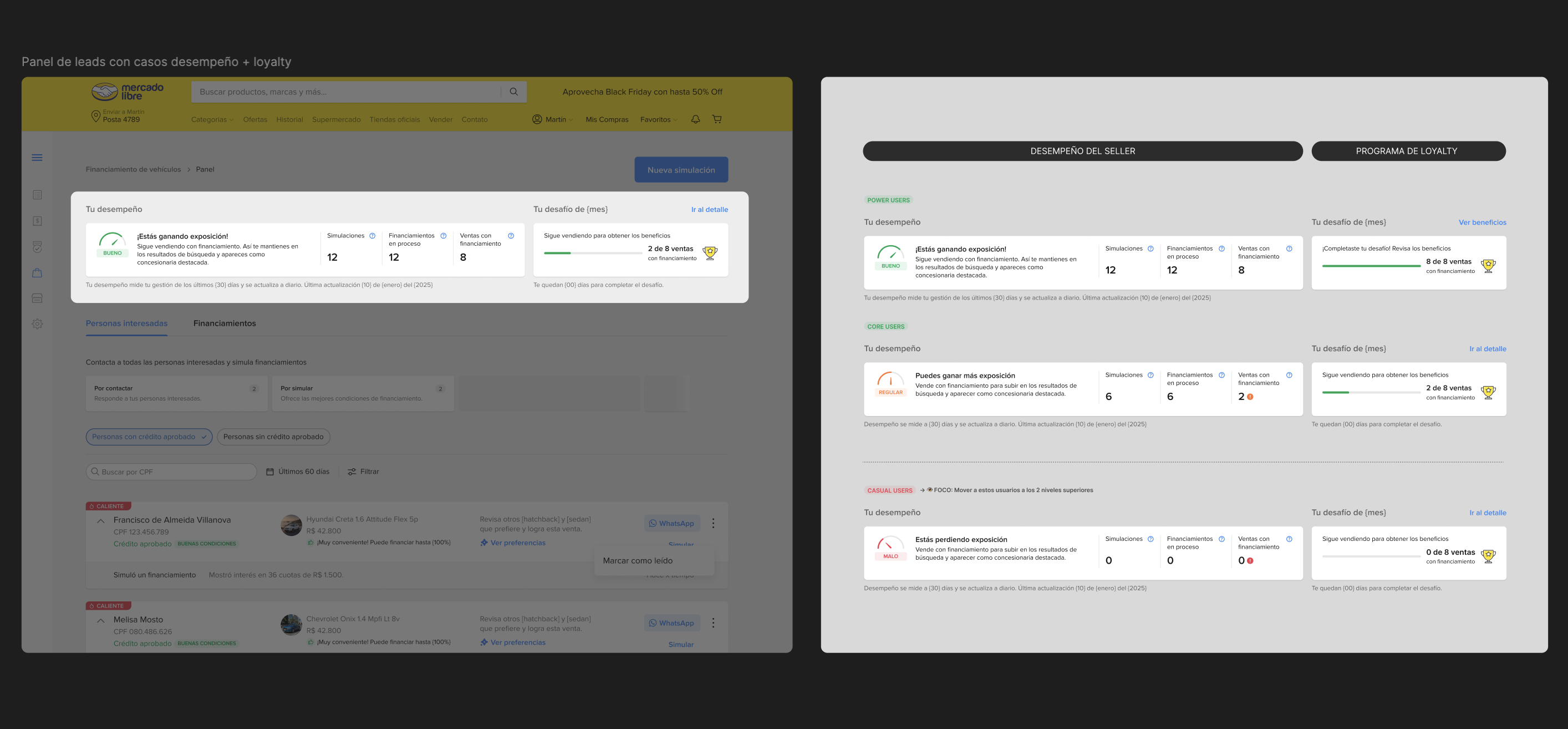
All sellers eventually had performance enabled, with a weekly refresh every Monday. Loyalty added a separate challenge journey for sellers selected and enrolled by the commercial team.
2024 · Seller Score B2C
Make performance visible to all sellers and offer stronger performers greater exposure and priority in search results.
2025 · Loyalty
Offer selected sellers a monthly financed-sales challenge, with a target based on their dealership’s size and lead flow.
Turn activity into understandable feedback.
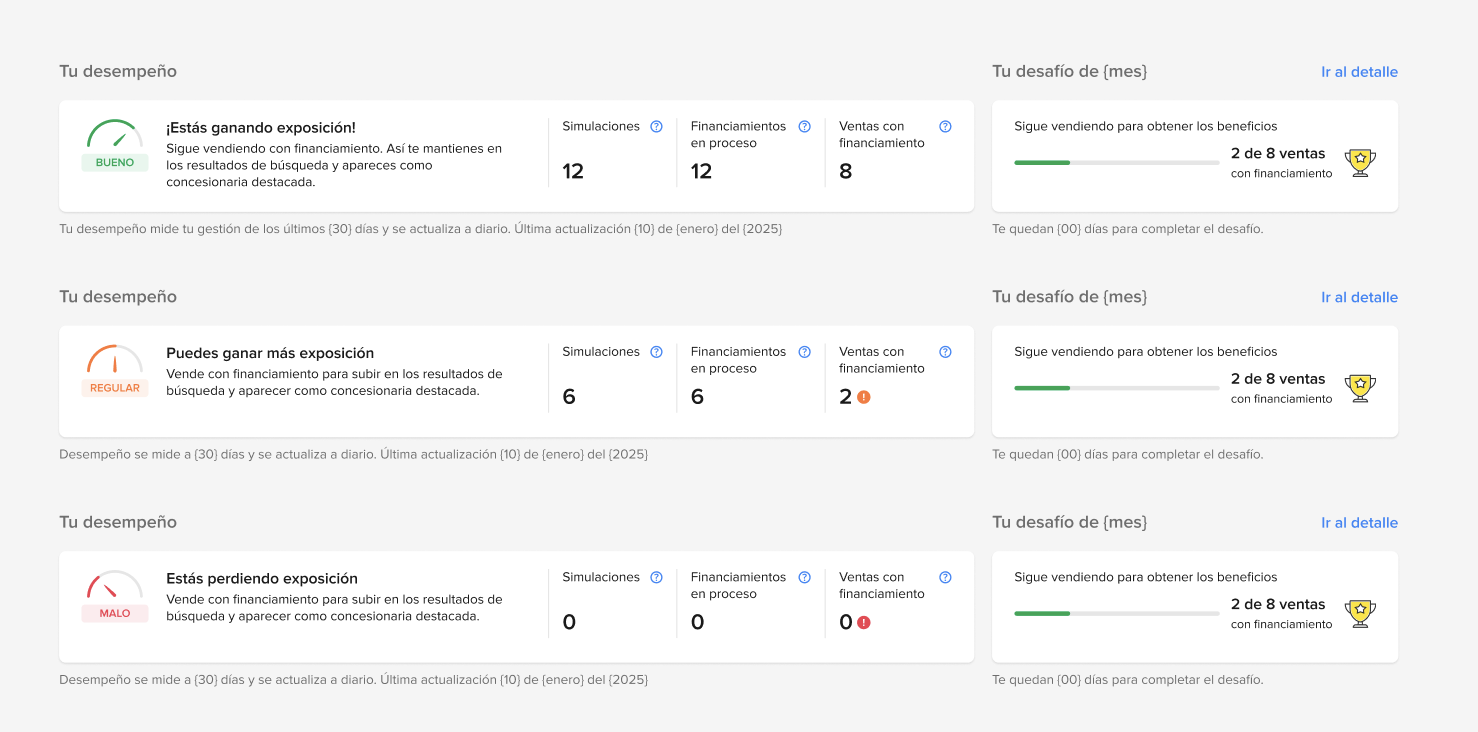
A points-based score brought together financing simulations, financing in progress, financed sales, and the frequency of access to the sales platform. The resulting performance level was Good, Fair, or Poor.
The seller-facing design paired the status with key metrics and messages about exposure. It made the benefit concrete: better performance meant greater visibility for listings in search.
Performance refreshed every Monday. Sustaining it meant maintaining or exceeding sales and staying active across the other score metrics.
- A recognizable status, supported by a label and visual indicator.
- Three activity metrics in the summary, with access frequency also informing the calculation.
- Contextual guidance connecting financed sales to search exposure.
A clear signal within a broader marketplace.
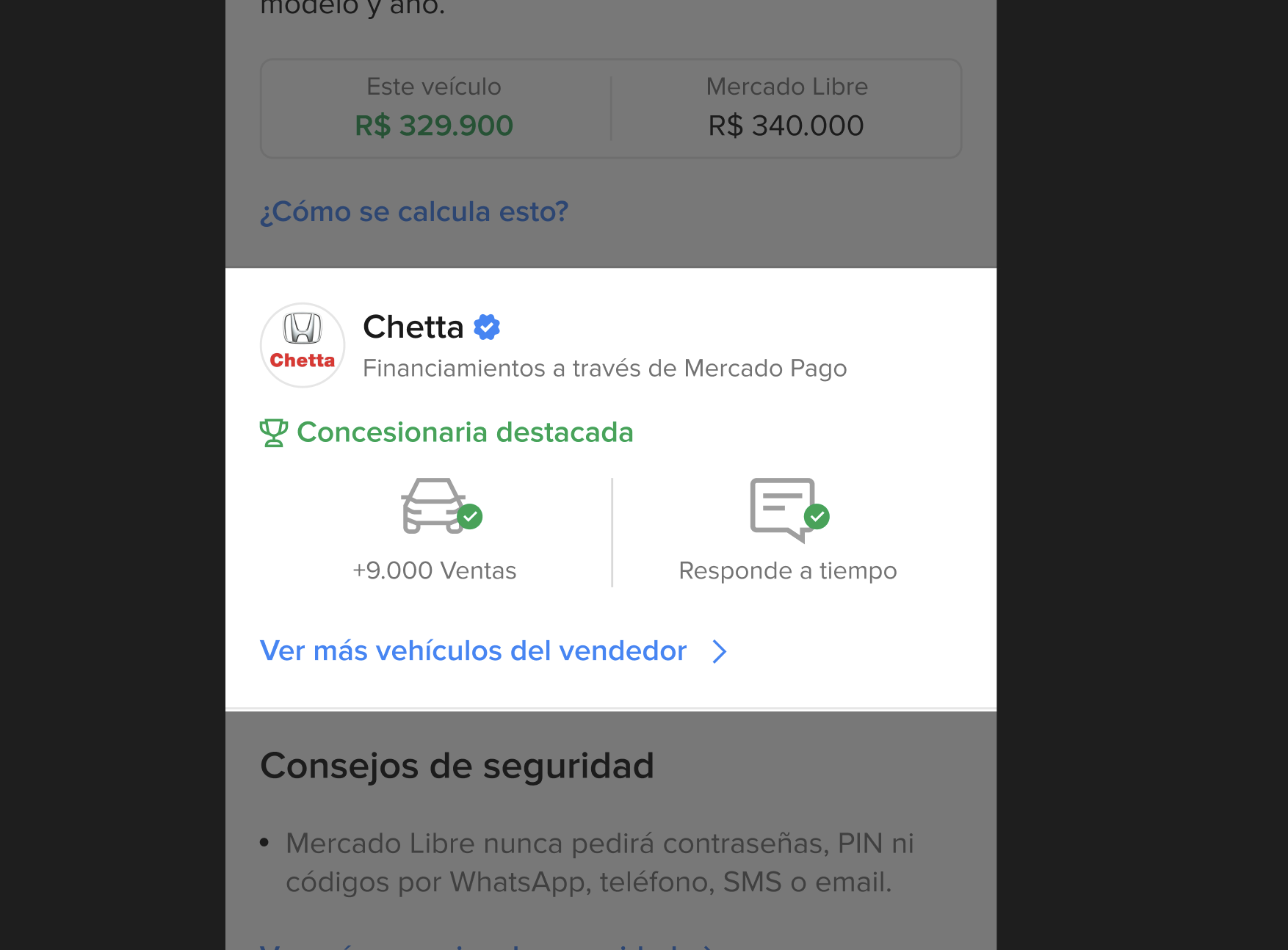
Together with Product, I defined how to explain the scoring system and the benefits of its highest level, integrate performance information into the financing sales platform, handle changes between performance states, and help buyers recognize stronger-performing sellers on product pages.
The main challenge was a focused strategy for Brazil: communicating performance in service and financed sales while fitting alongside seller-reputation systems elsewhere in the marketplace, which used different criteria. I organized and led discussions with leaders, managers, and directors to reach agreement on these definitions.
Design pairs on my team refined the details across two experience areas. We reviewed proposals, refined alternatives, and co-created the final solution together. I also participated in cross-functional triad refinement sessions.
Seller experience
Performance information within the financing sales platform, supported by onboarding and communications.
Buyer experience
A component on product pages to help buyers recognize sellers with stronger performance.
More lead share for engaged sellers.
Monthly measurements showed leads shifting toward more engaged sellers. By December 2024, the B2C seller base was approximately 4,000.
| Seller segment | Before | After | Change |
|---|---|---|---|
| Casual users | 35.8% | 33.1% | −2.7 pp |
| Core users | 54.5% | 56.5% | +2.0 pp |
| Power users | 9.8% | 10.4% | +0.6 pp |
Scroll to see all columns
pp = percentage points. These figures describe lead share, not the number of sellers changing segment.
Test the offer before committing to the full experience.
Business stakeholders wanted to announce the program quickly. At the same time, UX and Product saw an opportunity for stronger incentives, while the commercial team wanted to establish traction with a lower-cost first offer.
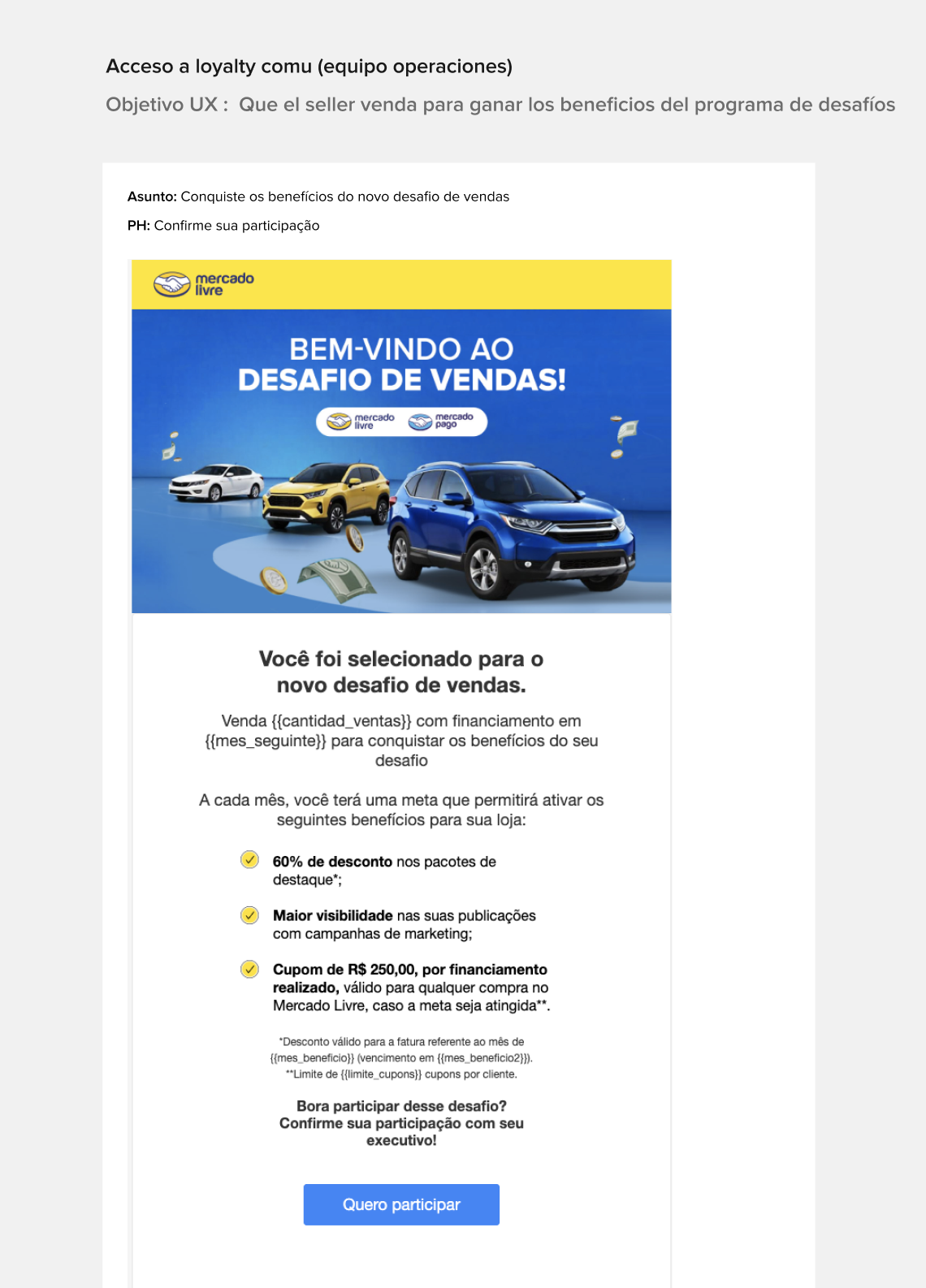
Together with Product, I co-led a proposal to test the initial benefits through seller communications before launching the in-platform MVP. We measured how many sellers chose to participate. The positive response helped us reach agreement to move forward.
Validate the value proposition
Find out whether the initial commercial offer gave sellers a reason to join.
Move forward with evidence
Use the participation signal to align stakeholders around the first in-platform MVP.
Lead the direction. Stay close to the work.
For loyalty, I worked alongside two Product Designers from early proposals to production. We refined design and content decisions together, keeping the experience connected to business value and delivery cost.
I partnered with Product on the MVP value propositions and benefits, and led UX decisions in triad discussions about the value and cost of each choice.
- Co-shaped the first offer with Product.
- Coached two designers through exploration and refinement.
- Guided content and design decisions through production.
- Made scope and cost trade-offs explicit with the cross-functional team.
A clear challenge, visible progress, earned benefits.
Once the commercial team enrolled a seller, the loyalty journey appeared inside the financing platform. Each monthly challenge had a specific financed-sales target based on the dealership’s size and lead flow.
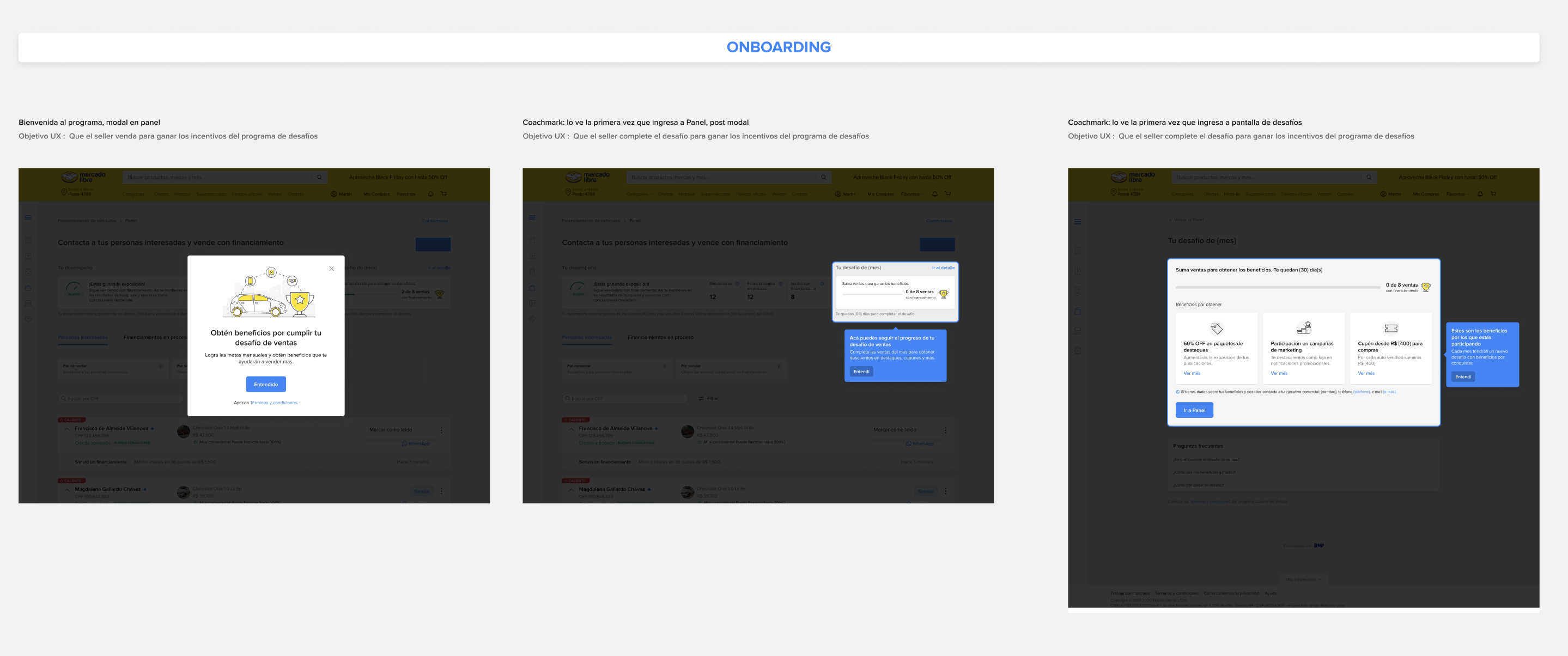
The design introduced the offer through a welcome modal, then used first-visit coachmarks to show where to track progress and where to explore benefits. Sellers could follow sales against their target, see the remaining time, and open the challenge details.
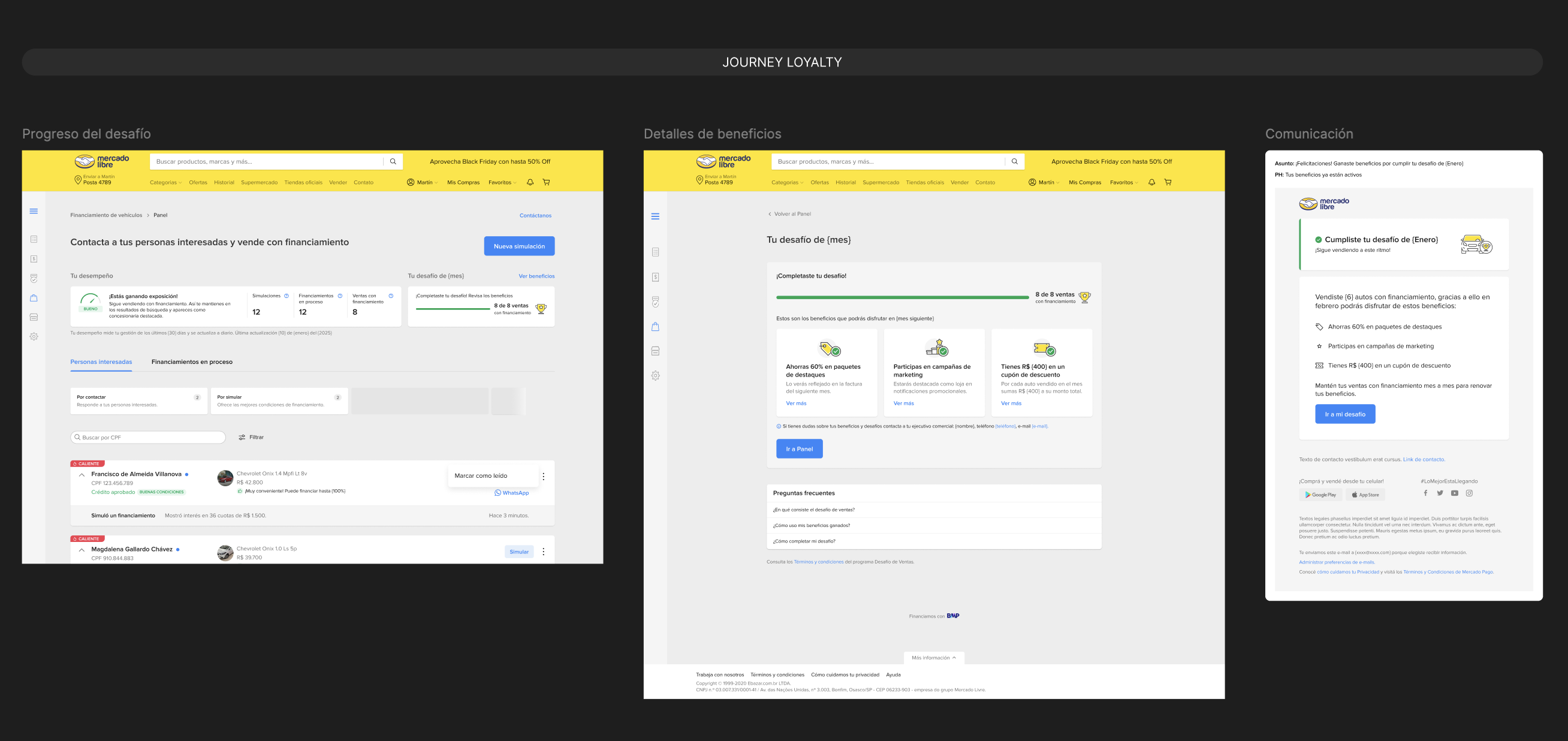
The completion journey connected the dashboard state with earned-benefit details and a congratulatory email. The design showed discounts on listing-promotion packages, participation in marketing campaigns, and shopping coupons.
Discover and follow the challenge
A welcome modal introduced the program. Guided cues connected the dashboard summary to the target, progress, and benefit details.
Recognize completion and earned benefits
The completed state linked to earned rewards, with an email reinforcing the achievement. The detail also offered FAQs, terms, and contact with a commercial representative.
From a first offer to monthly business impact.
Seller Score B2C launched in 2024. Loyalty followed in 2025, bringing the first incentive experience into the sales platform.
Following launch, loyalty generated approximately 30 additional financed vehicle sales and US$15,000 in additional contribution per month, supporting the new vehicle-financing business model in Brazil.